The risk engine for the physical world

Your FMEA is wrong.It just can't tell you yet.

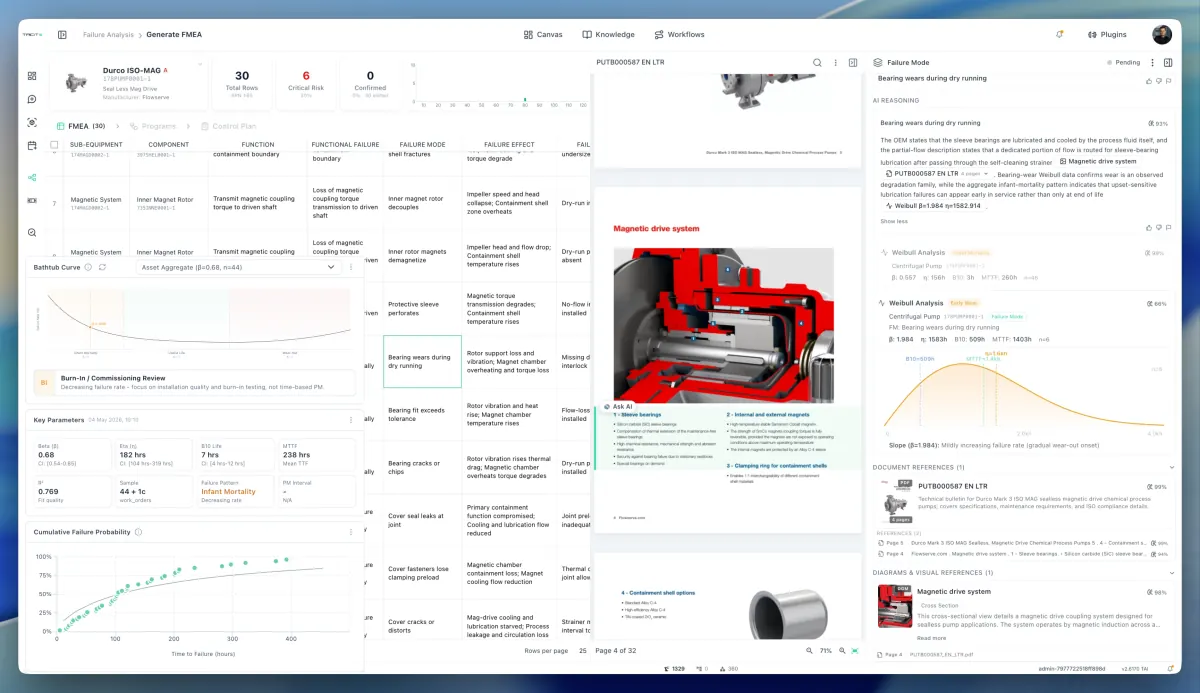
Tacit AI builds and maintains your DFMEAs, PFMEAs, FMECAs and control plans, updating them with every test, defect and failure. Every row traced to its source.

Account live in under an hour. First results in days.

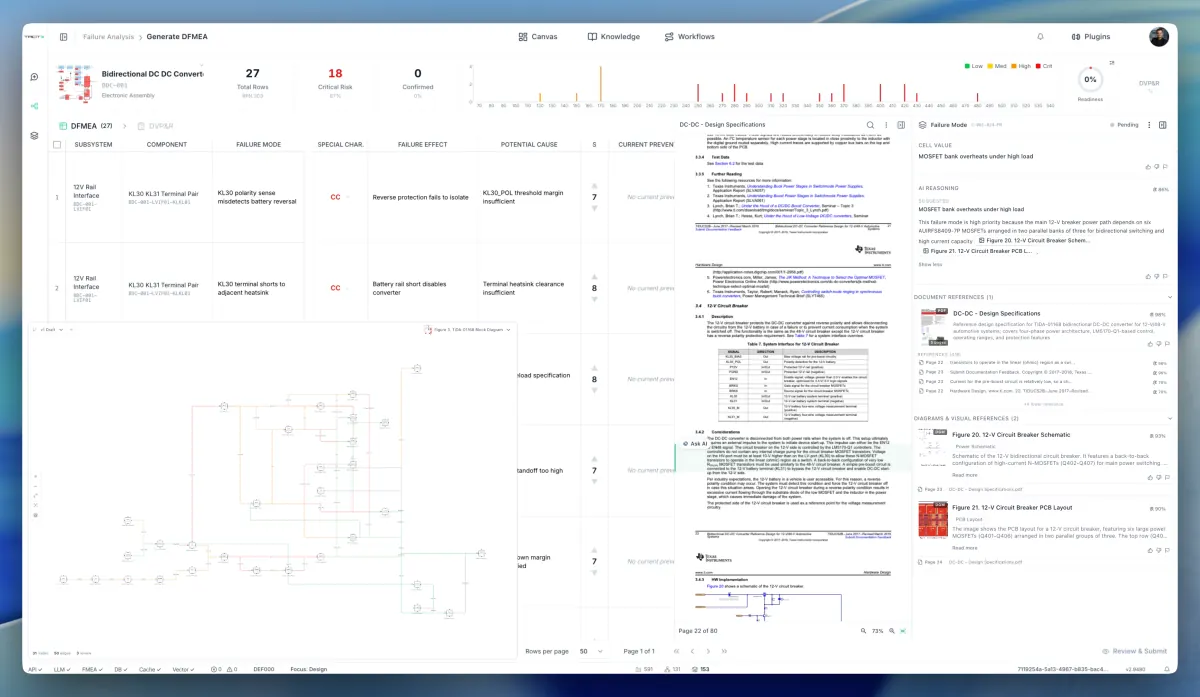
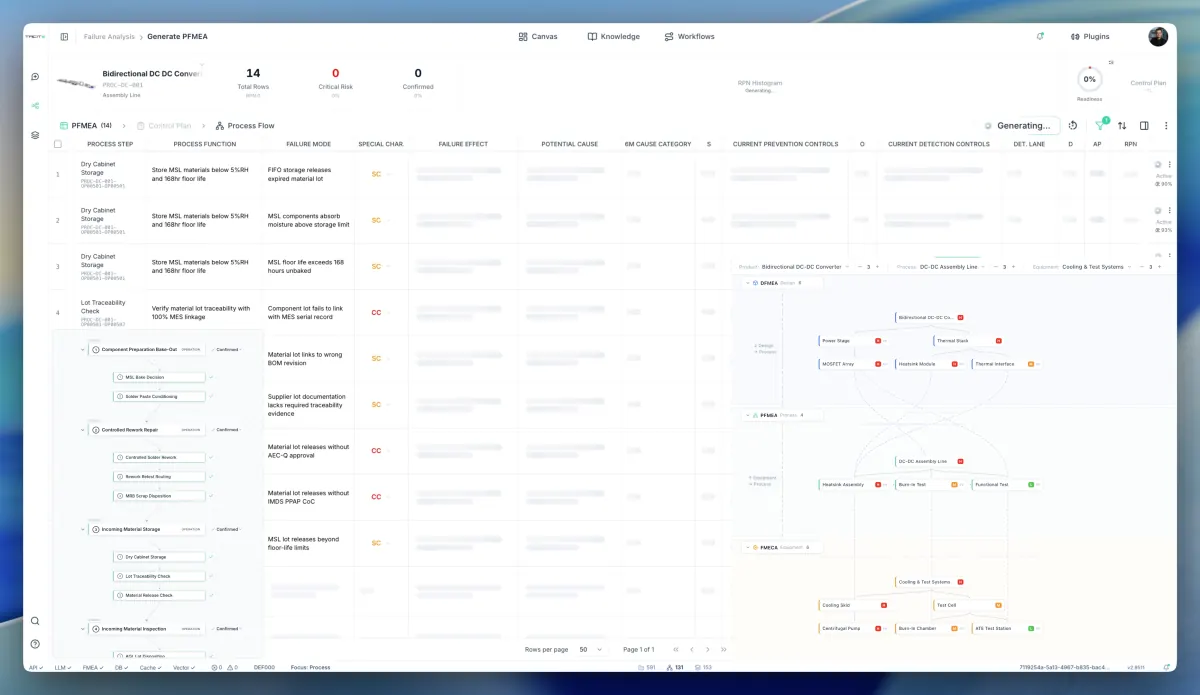
Tacit AI DFMEA workspace: failure modes generated from design specs with AI reasoning and source traceability Tacit AI PFMEA workspace: process steps, 6M cause analysis, and control plan links Tacit AI FMECA and reliability workspace: Weibull analysis, criticality, and work order feedback
Explore Design Risk

Up to $24 billion. 67 million inflators recalled in the US.

The evidence existed for years before anyone connected it. Takata, 2008-2024.

Test results, warranty claims, supplier escapes and field complaints stayed outside the FMEA until it was too late.


Measured results from customer deployments

8×
faster FMEA generation
Top 20 Global OEM
80-90%
engineer-ready on first delivery
Automotive, Mining, Chemicals
100%
of rows traced to their source
Every deployment
100,000+
FMEA rows generated
Across all deployments
15.3%
less unplanned downtime
Top 10 Global Pharma

Continuous Risk Intelligence

One risk engine, connected to every system you already run.

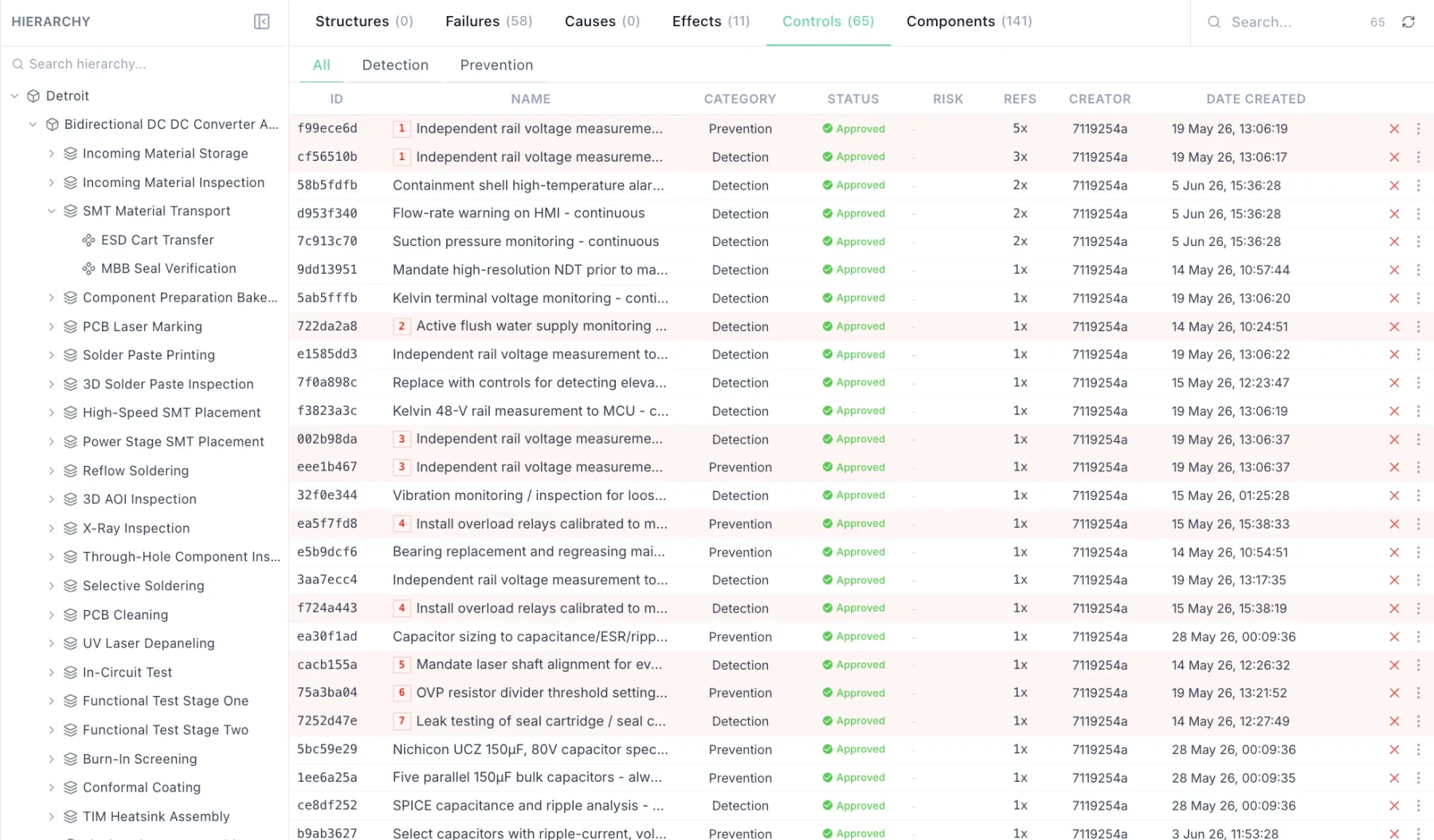
It reads your failure reports, tests and 8Ds, keeps every FMEA current and learns from every engineer decision. Nothing to rip out.

The platform

Everything you already have.
Turned into risk strategy you can defend.

Click to pause

Why Tacit AI

Keep what you run today. Add the part it’s missing.

Tacit AI works on top of the tools you already have. Nothing to replace.

You have
Copilot or ChatGPT

It drafts an FMEA, then forgets it. A correction stays in one chat.

Tacit AI keeps every correction and applies it to every related row.

You have
A tool you built in-house

Built around how your engineers work. It still needs an engine.

Tacit AI is that engine, with every capability over API.

You have
Your FMEA tool

APIS IQ, PLATO or Excel holds the FMEA. 8Ds and field data stay outside.

Tacit AI flags the rows your 8Ds, complaints and failure reports change. Your tool stays the record.

Masters and variants

One master FMEA.
Every variant derived from it.

Build the master once. Each variant gets its own FMEA from it and stays in step when the master changes.

The master
Every row, once

One FMEA holds every row of every configuration. Options mark the rows only some of them have.

Already have FMEAs? They join the family and keep their own rows.

A variant
Pick its options

Choose the options a variant takes. Tacit AI derives its FMEA from the master.

Preview first. You see its rows before it is created.

A change
Reaches the family

Change the master and every variant shows what it is missing. Your engineer pulls it in.

Both ways. A row a variant adds can go back to the whole family.

Enterprise control

Deploy where your enterprise approves.

Your cloud, your data centre or fully disconnected. Single sign-on through your identity provider, role-based access, encryption at rest and in transit, US or EU data residency, no prompt retention by default, and your data never trains a model.

01

Your approval

Nothing enters a controlled record until your reviewer approves it. Every decision versioned and reversible.

02

Your infrastructure

Your VPC on Azure, AWS or GCP, live in days. On-premise or air-gapped. Your LLM gateway or ours.

03

Your audit trail

Every change, citation and decision exportable, logged by user, system and operation.

04

Your knowledge

Failure libraries, corrections and rules stay yours. Export any time and switch models freely.

Enterprise FAQ

The technical and commercial questions that matter.

All 3, on one risk engine. Design FMEA (DFMEA) with DVP&R, Process FMEA (PFMEA) with control plans, and equipment FMEA and FMECA with RCM. They connect: a design risk flows from the DFMEA to the PFMEA and its control plan. See the standards built in

No. Tacit AI does the analysis and delivers cited, specific changes. Your engineers own scope, ratings, controls and release, and every decision is attributed and versioned. The leverage is simple: specialists judge structured evidence instead of building the first draft by hand. See how every decision is kept

That’s where we start. Data quality is scored field by field before analysis, so missing identity, dates, failure coding and operating context are visible from day one. Messy records, PDFs and spreadsheets all work. For greenfield work, specifications, BOMs, OEM manuals and reference libraries provide the starting evidence. See how data quality is scored

Keep it. Tacit AI reads your existing FMEAs and connects to the systems that hold your 8Ds, complaints, failure reports and test results, then checks every row against them. An assistant inside an FMEA tool suggests entries. Tacit AI builds the full FMEA, every row traced to its source, and flags the rows new evidence changes. Your engineers approve every change. Approved changes export to Excel, so your tool stays the record. See integrations · What AI means in FMEA software

Any model can draft an FMEA now. That isn’t the problem. The problem is keeping 500 of them consistent across 30 sites, and updating them when a failure report contradicts failure mode #12. Tacit AI links every row to page-level evidence, scores source quality, applies controlled taxonomies, records every reviewer decision and flags rows when their evidence changes. The model underneath is swappable. See the full comparison

They could build the generator. Drafting an FMEA is the easy part now. The hard part is the history: every correction, reviewer decision and link from a failure report to an FMEA row, kept consistent across hundreds of assets and many sites, and still maintained after the person who built it moves on. Tacit AI runs in your cloud, on your models, and your data stays exportable. You’re buying the system that keeps the learning running, not a document generator. Compare every path

Yes. The standard path is a VPC in your Azure, AWS or GCP account, live within days, with a dedicated database per customer. Run on-premise with your own models for production, or fully disconnected. Connect your enterprise LLM gateway (Azure OpenAI, AWS Bedrock, Google Vertex AI, internal endpoint) or use ours. Your data stays inside your boundary. Encryption at rest and in transit, MFA through your identity provider, RBAC, audit logging and full data export come standard. See security and compliance

Start with one system and their standard. They type or speak in 40+ languages and approve every change. Cited output arrives in their own templates, ready for their FMEA tool, PLM or maintenance system. Corrections, acceptance and review effort are measured before anything expands. If the output misses the agreed standard, Phase 1 stops there. See how Phase 1 works

With your own numbers. Phase 1 starts from your baseline: engineering hours, analysis backlog, review cycle, repeat-event cost or production exposure. Tacit AI reports review effort, accepted coverage and decision value for the selected system. The business case is built on measured results, not generic ROI assumptions. See customer results

From the field

What we’ve learned building FMEAs for the hardest industries.

Software dashboard on a laptop

Best FMEA Software in 2026

APIS IQ, PLATO e1ns, Teamcenter, Windchill, Relyence and Tacit AI compared on features, standards and fit.

Read article

Automotive manufacturing shop floor

Reverse FMEA: OEM Mandates & How to Close the Loop

Ford, Stellantis, Renault, and GM mandate R-FMEA. What the CSRs say and how to connect findings to your PFMEA.

Read article


Medical device regulatory

QMSR Is Live: FMEA Requirements for 2026

FDA QMSR is effective. ISO 13485 risk management is the inspection standard. What this means for your FMEA.

Read article


Quality investigation

Rebuilding FMEA After a Recall

The root cause traced back to the FMEA. How to rebuild with traceability and defensible risk analysis.

Read article


AI comparison

Why ChatGPT Fails at Industrial Risk Analysis

General-purpose AI forgets your context. Persistent memory, feedback loops, and traceability change everything.

Read article


Automotive brake DFMEA

Automotive DFMEA Example: Brake Caliper Walkthrough

Complete AIAG-VDA 7-step DFMEA for an electric parking brake caliper. Structure analysis, failure modes, Action Priority scoring.

Read article


Automotive stamping PFMEA

PFMEA Example: Automotive Stamping Step-by-Step

Complete PFMEA for metal stamping. 4M cause analysis, Action Priority scoring, and control plan linkage with 10 worked rows.

Read article


FMEA template worksheet

FMEA Template: Free Worksheet for DFMEA, PFMEA & FMECA

Column-by-column template structures for AIAG-VDA, IEC 60812, and ISO 14971. Scoring tables included.

Read article


AIAG-VDA FMEA software

AIAG-VDA FMEA Software: What Suppliers Need

7-step method support, Action Priority tables, structure analysis, and DFMEA-to-PFMEA linkage. Evaluation checklist.

Read article


State of FMEA in 2026

The State of FMEA in 2026

Why FMEAs remain static in spreadsheets - and how engineering teams can reconnect them to changing field evidence.

Read the report

“We evaluated Tacit AI for Design FMEA on a critical subsystem. The structured output and the approach to connecting information exceeded expectations.”
Design FMEA
Exceeded expectations

“We can draft multiple FMEA per day, compared to one every week before Tacit AI. The improvement in data quality and standards helps us accelerate improvements.”
1/week → multiple/day
8× faster FMEAs

“I’ve been evaluating top-quartile solutions for the past year. Even the best ones don’t have what Tacit AI offers. The combination of AI-generated FMEAs, data quality scoring, and source traceability is unlike anything else available.”
1 year eval
Nothing compares

“We tested Tacit AI to build an FMEA for a critical screener. We gave it troubleshooting and maintenance PDFs, a BOM in Excel and a few sentences of context. The output was an 80-90% ready FMEA with mitigating tasks, work instructions and clear AI reasoning that our engineers could quickly adapt and load into our reliability system.”
80-90% engineer-ready
Days, not months

“Without Tacit AI, the critical gaps hidden in 20,000 failure logs would have stayed invisible. The 2.7x data quality improvement was just the beginning.”
15.3% less downtime
20,000 failure reports

“Tacit AI helped us access manuals, drawings, and procedures instantly, reducing desk trips. Field teams spend more time on assets. The rolling mill pilot is just the beginning in our digital transformation journey.”
42 min saved per workflow
Multi-lingual

“Where AI can really help us is studying data from multiple sites in multiple languages to identify common failure patterns. That has a lot of value.”
Cross-site patterns
40+ languages

“Tacit AI flags complex bad actor patterns our team missed. The context graph connects work orders, manuals, and failure modes automatically.”
4 repeat failures flagged
Standardization

“From 20,000 failure reports and 100+ manuals, Tacit AI surfaced 56 data quality and failure attributes we had no visibility into. First actionable results came within 4 weeks.”
56 attributes surfaced
ROI in 4 weeks

“The benefit of using AI is to find 100,000 $100 improvements. We have no practical means to do that manually. It’s not possible.”
100K × $100 gains
Not possible manually

“We have 30,000 functional locations across 10 offshore platforms. Organizing strategies manually would take years. When we saw the automated failure-mode mapping and PM effectiveness tracking - it was like a miracle.”
Years → weeks
30K assets covered

“Tacit AI is a fantastic solution for quickly getting to a high-quality FMEA without a heavy resource load on our Reliability Engineers.”
80-90% engineer-ready
Days, not months

“Technically, it convinces me. I know this is the future of maintenance management. We spent six months on one machine’s RCM and still aren’t finished. This compresses that to days.”
6 months → days


“We evaluated Tacit AI for Design FMEA on a critical subsystem. The structured output and the approach to connecting information exceeded expectations.”

Design Engineer, Top 10 Global OEM, DFMEA, Europe

“We spent six months on one machine’s RCM and still aren’t finished. This compresses that to days.”

Maintenance Coordinator, Global Cement - Kiln & Mill RCM

Pick one critical system.
See the failures nobody connected.

One system. Your data. Results in days.

“We evaluated Tacit AI for Design FMEA on a critical subsystem. The structured output and the approach to connecting information exceeded expectations.”

Design Engineer, Top 10 Global OEM, DFMEA, Europe

Cookie settings
Necessary cookies keep the site working and are always on. Analytics and advertising cookies are only set if you allow them. You can change this at any time. Privacy policy
Necessary
Allow Necessary cookies.
Analytics
Allow Analytics cookies.
Advertising
Allow Advertising cookies.